
Monday 9 – Friday 15 September 2024 is Air Ambulance week, dedicated to raising awareness and funds for the vital lifesaving work of air ambulance charities, organised by Air Ambulances UK. We invited Senior Case Manager Rosie Bond to share her insights on living remotely and the challenges associated with injuries and the air ambulance service.
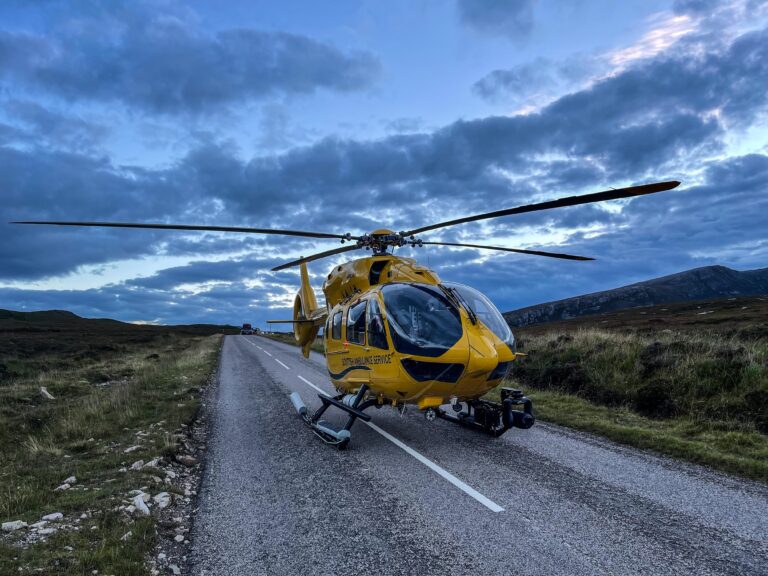
“Living in the Scottish Highlands and traveling up and down a major road frequently for work as a senior case manager in Scotland, I know only too well the importance of the Scottish Air Ambulance service. I often see/hear an air ambulance either whilst at home, traveling around visiting clients in my role as Case Manager or whilst camping rurally.
The Summer is particularly busy for the service as we have a huge influx of visitors from abroad and from other parts of the UK. I live on the famous route the North Coast 500 which attracts motorbike groups and camper vans. There are daily and multiple accidents on our roads – some minor but some are major catastrophes. Only last year there was a serious accident on the A9 along from my house which required the service of the air ambulance which needed to land on the road due to access to the accident.
In Scotland we have a charity which provides this service – Scotland’s Charity Air Ambulance (SCAA) which relies on donations from the community and fundraising events. They work in partnership with the Scottish Ambulance Service (SAS).
The SCAA currently operates two helicopters, both EC135-T2is, and two rapid response vehicles – taking life-saving pre-hospital care to the scene of time-critical emergencies. SCAA then transports patients to hospitals all over Scotland to receive the most appropriate medical care.
SCAA is an integral part of Scotland’s frontline emergency response network, responding to trauma incidents and medical emergencies across the country, covering an area of more than 30,000 square miles.
Parts of the Scottish Highlands are so remote and the only way to get help near to the scene of the incident is by helicopter and so these services are essential and integral to saving lives.
The service is delivered through a managed contract of two helicopters; one based in Glasgow and one in Inverness and two fixed wing aircraft; one at Aberdeen Airport and one at Glasgow Airport. In addition to the four government funded aircraft, the service is supplemented by two helicopters provided by Scotland’s Charity Air Ambulance.
A national multi-disciplinary team of paramedics, nurses, advanced practitioners, and doctors, work together to provide a flexible and responsive service that offers timely, safe and effective care for patients.
Not just for car accidents but heart attacks, stroke etc care as soon as possible is vital for the best outcome for that patient.
An ex-client of mine needed their support when he and his friend were both knocked off their road bikes whist cycling/training for a big event on the west coast of Scotland. My client suffered a severe brain injury along with multiple orthopaedic injuries and the rapid response of the air ambulance service was vital in his treatment and care before being flown to hospital for immediate and urgent surgery.”
-Rosie Bond, Senior Case Manager, Scotland


